
MDR vs SOC vs SIEM vs XDR: What MSPs Actually Need (2026)
The alphabet soup of security services confuses everyone. Here's a clear breakdown of MDR, SOC, SIEM, XDR, and which ones actually matter for your MSP.
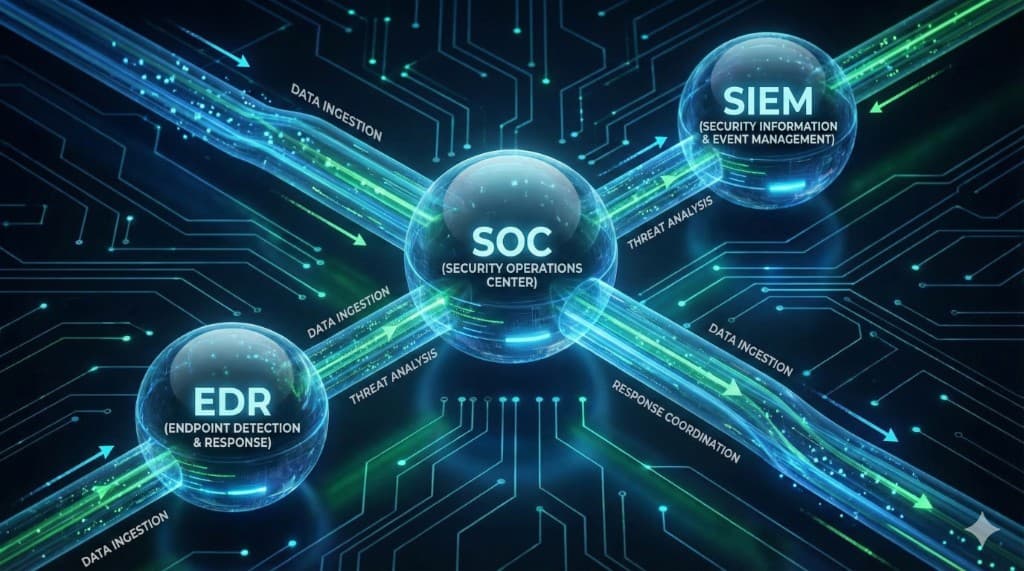
TL;DR
Most MSPs need only four components, not fifteen: a strong EDR platform, email security, an MDR service for 24/7 monitoring, and a unified platform to manage it all.
Key takeaways
- EDR and MDR (or internal SOC capability) are must-haves; XDR-like visibility and basic automation are should-haves; full SIEM and enterprise SOAR are nice-to-haves most MSPs do not need.
- MDR combines tools plus people and is effectively renting a SOC instead of building one; a SOC is a team monitoring security 24/7.
- XDR extends EDR across email, network, cloud, and identity layers, catching more threats than endpoint visibility alone.
- Full SIEM and enterprise SOAR are usually overkill for MSPs because they are expensive, complex, and require dedicated security engineers.
- Vendor consolidation (Microsoft Defender bundling, Palo Alto acquisitions, SentinelOne and CrowdStrike expanding) helps MSPs avoid stitching together 12 vendors.
MDR vs SOC vs SIEM vs XDR vs SOAR — side by side
| Acronym | What it is | What it does | Who operates it | When an MSP needs it | Cost model |
|---|---|---|---|---|---|
| EDR | Endpoint Detection & Response | Detects and remediates threats on each device | You / your tooling | Always — non-negotiable baseline | Per endpoint/month |
| SIEM | Security Information & Event Management | Collects and correlates logs, raises alerts | You (needs security engineers) | Compliance/log-retention mandates; larger clients | Per GB or per seat/month |
| SOC | Security Operations Center | People monitoring and responding 24/7 | In-house team or outsourced | When someone must watch alerts around the clock | Staff cost or bundled into MDR |
| MDR | Managed Detection & Response | Tools + people: outsourced 24/7 detection and response | A provider (you rent the SOC) | To offer 24/7 without building a SOC | Per endpoint or per user/month |
| XDR | Extended Detection & Response | EDR extended across email, network, cloud, identity | You / your tooling | When endpoint-only visibility misses threats | Per endpoint/month (platform) |
| SOAR | Security Orchestration, Automation & Response | Runs automated response playbooks | Mature SOC teams | Rarely for SMB MSPs — usually overkill | Platform license |
The short version for most MSPs: EDR + MDR + email security on one platform covers the vast majority of need. Add SIEM when a client has log-retention or compliance mandates; leave enterprise SOAR to enterprises.
MDR. XDR. SIEM. SOC. EDR. SOAR.
If your head is spinning, you're not alone. The security industry loves acronyms, and vendors love making their solution sound unique. Let me cut through the noise.
Let's Define Everything (Simply)
EDR - Endpoint Detection & Response
What it is: Software on endpoints that detects threats and enables response.
Think of it as: Advanced antivirus that can investigate and remediate.
Example: SentinelOne, CrowdStrike, Microsoft Defender for Endpoint
SIEM - Security Information & Event Management
What it is: Collects logs from everywhere, correlates events, generates alerts.
Think of it as: Your security data warehouse with alerting.
Example: Splunk, Microsoft Sentinel, IBM QRadar
SOC - Security Operations Center
What it is: A team (and often a physical location) that monitors security 24/7.
Think of it as: People watching screens and responding to alerts.
Example: Your internal team or outsourced provider
MDR - Managed Detection & Response
What it is: Outsourced security monitoring and response. Combines tools + people.
Think of it as: Renting a SOC instead of building one.
Example: Arctic Wolf, Huntress, Fortress MDR
XDR - Extended Detection & Response
What it is: EDR extended across multiple security layers (email, network, cloud, identity).
Think of it as: EDR that sees everything, not just endpoints.
Example: Palo Alto Cortex XDR, Microsoft 365 Defender
SOAR - Security Orchestration, Automation & Response
What it is: Automates security workflows and incident response.
Think of it as: Playbooks that run automatically when threats are detected.
Example: Splunk SOAR, Palo Alto XSOAR
What Do MSPs Actually Need?
Here's my honest take after 28 years in this industry:
Must Have
- EDR: You cannot operate without modern endpoint protection. Non-negotiable.
- MDR (or internal SOC capability): Someone needs to watch and respond to alerts 24/7.
Should Have
- XDR or XDR-like visibility: Correlating endpoint + email + identity catches more threats.
- Basic automation: You don't need full SOAR, but automated playbooks save hours.
Nice to Have
- Full SIEM: Most MSPs don't need to build their own SIEM. It's expensive and complex.
- Enterprise SOAR: Unless you have dedicated security engineers, this is overkill.
The MSP Stack I Recommend
For most MSPs serving SMB clients:
- Strong EDR platform (SentinelOne, CrowdStrike, or Microsoft Defender)
- Email security (Proofpoint, Perception Point, or Microsoft Defender for O365)
- MDR service for 24/7 monitoring (or build hybrid SOC)
- Unified platform to manage it all (this is where Fortress comes in)
That's it. Four components. Not fifteen.
The Vendor Consolidation Trend
Here's what's happening in the market: vendors are consolidating.
- Microsoft is bundling everything into Defender
- Palo Alto bought XDR, SOAR, and threat intel companies
- SentinelOne and CrowdStrike are adding capabilities beyond EDR
This actually helps MSPs. You don't need to be a systems integrator stitching together 12 vendors. Choose platforms that work together.
Questions to Ask Vendors
When evaluating any security tool:
- "How does this integrate with my existing stack?"
- "What's included in the price vs. what costs extra?"
- "Is there 24/7 human response, or just automated alerts?"
- "How long does deployment take for a typical client?"
- "What does the MSP dashboard look like? Can I manage all clients in one place?"
The Bottom Line
Don't get distracted by acronyms. Focus on outcomes:
- Can you detect threats across your clients' environments?
- Can you respond quickly when something bad happens?
- Can you manage everything without drowning in complexity?
If yes to all three, you've got the right stack. Everything else is marketing.
See how Fortress brings it all together →
Want to see your specific numbers?
Run your business through our free MSP Security Economics Calculator. No email gate, no marketing nurture — just plug in your real inputs and see your real P&L in 60 seconds.
Explore more: explore the platform · the true cost of vendor sprawl · questions to ask your IT provider

WRITTEN BY
Menachem TaumanCo-Founder & CEO, Fortress Cyber
Serial entrepreneur with 28+ years of experience in cybersecurity and IT. Former CISO who has advised governments, banks, and Fortune 500 companies. Co-founded QMasters, a successful MSSP (exit x1), and pioneered the "Integrative Cyber Defense" approach. At Fortress, he's building the Channel Enablement OS that transforms how MSPs deliver and monetize cybersecurity.
Follow on LinkedInReady to Transform Your MSP?
See how Fortress can help you build a profitable security practice.
Request a Demo