
What's the Most Common Way Small Businesses Get Hacked?
88% of small business breaches involve ransomware — and it almost always starts with one phishing email. Here's how attacks actually unfold, what they cost, and how to stop them.
TL;DR
The most common way small businesses get hacked is a phishing email leading to ransomware — 88% of SMB breaches involve ransomware, and it almost always starts with a single employee clicking one link or attachment.
Key takeaways
- 88% of small business breaches involve ransomware, and attackers blast hundreds of thousands of phishing emails as a numbers game needing just one click to get in.
- Once inside, attackers either encrypt within hours or sit for days mapping systems, finding and encrypting backups, and stealing data before locking everything.
- 43% of all 2025 cyberattacks targeted small businesses, and 55% of ransomware hits companies with fewer than 100 employees — small means targeted, not safe.
- Average breach recovery runs $1.53 million before any ransom, takes days to weeks, and 1 in 5 affected owners go bankrupt or out of business within months.
- Stopping it requires three things: enterprise-grade technology that works, around-the-clock network monitoring, and a real incident response plan — beyond what generalist IT providers deliver.
Let me tell you something. Eighty-eight percent of small business breaches involve ransomware. Not malware. Not data theft. Encryption that locks your entire operation out and demands money.
And it starts the same way almost every single time: a phishing email.
How the Attack Actually Unfolds
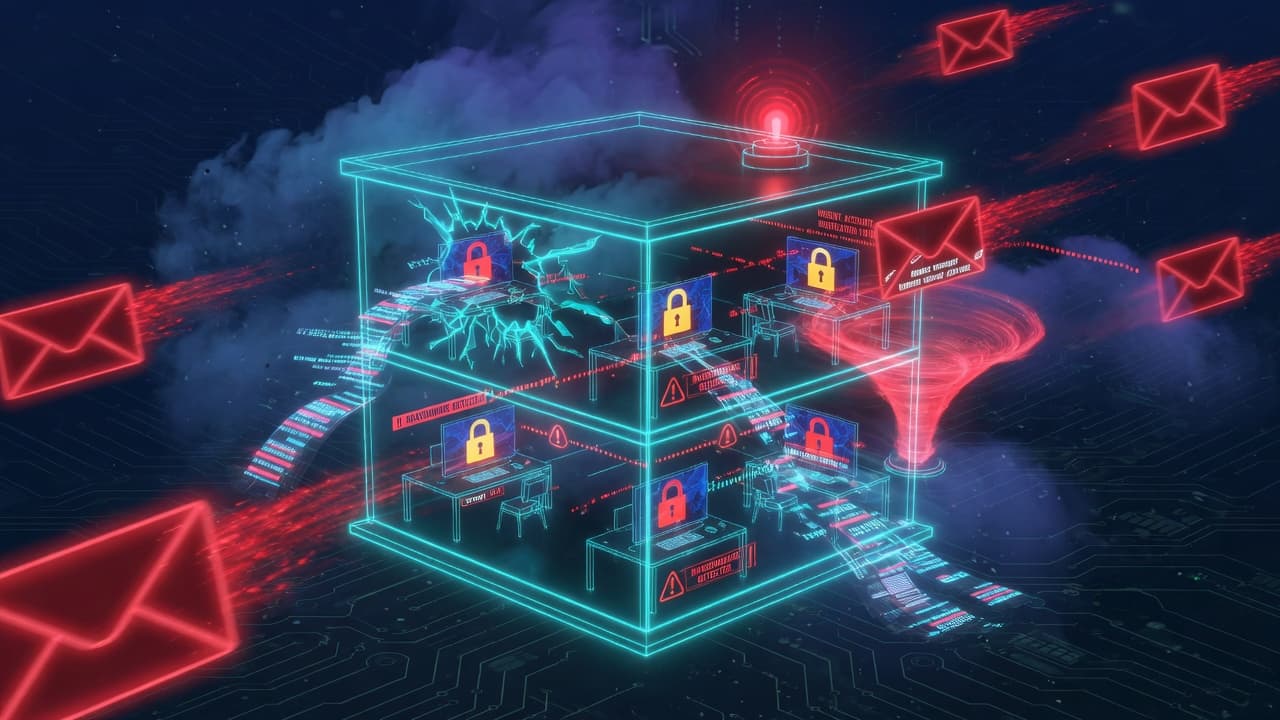
An attacker sends hundreds of thousands of phishing emails. It's a numbers game. They're not targeting you specifically — they're casting a net, and they don't care which fish lands in it. All they need is one employee to click. One link. One attachment opened. That's the entry point.
From there, it depends on what the attacker wants.
Sometimes they move fast — hours. They encrypt everything immediately and send you a ransom note before you even know they're in. Other times, they sit in your network for days. They map your systems, find your backups, steal your data first, then encrypt it all at once. That way, even if you recover from backup, they still have your customer information, your financial records, your trade secrets to sell or leak.
Why Small Businesses Are the Target
Forty-three percent of all cyberattacks in 2025 targeted small businesses. Not because you're the main prize. Because you're easy.
You don't have a security operations center watching 24/7. You probably have basic antivirus that hasn't stopped an advanced attack in years. Your IT provider is a generalist — they're good at keeping your printers working, not at detecting an intruder three layers deep in your network.
I saw it happen. Years ago at QMasters, we worked with companies that got completely encrypted. Destroyed. No backups to recover from — because the attackers encrypted those too. Some of those businesses never came back. They spent weeks trying to rebuild from scratch, if they could rebuild at all.
The Real Cost of a Breach
One in five small business owners who experience a breach go bankrupt or out of business within months.
The cost is brutal. Average recovery runs $1.53 million. That's before ransom. That's just getting operational again.
And the timeline? Days, sometimes weeks. During that time you're not serving customers, not fulfilling orders, not making money, and your reputation is bleeding out.
The Denial That Kills Small Businesses
Here's the thing that keeps most small business owners up at night: they think it won't happen to them.
They think attackers go after the big targets. They think their small operation is beneath notice. That's the denial talking. And it's wrong.
Fifty-five percent of ransomware hits businesses with fewer than one hundred employees. You're not safe because you're small. You're a target because you're small.
So What Actually Stops This?
Not cheap tools. Not your IT guy doing security part time. It stops with three things:
- Enterprise-grade technology that actually works
- Someone watching your network around the clock
- A real plan with real response when something goes wrong
Here's the reality most IT providers won't tell you. They're not security specialists. They're IT generalists. They keep your printers working and your email flowing. But detecting an attacker three layers deep in your network? Responding to a breach at two in the morning? That's a different skill set entirely. It requires enterprise-grade tools, continuous monitoring, and experience.
If you want to know what to ask your current provider before assuming they have this covered, here are the four questions every SMB owner should be asking right now.
Where Fortress Comes In
This is where Fortress comes in — but not for you to buy directly. Fortress is built for your IT provider, your MSP. It gives them the platform, the AI-powered monitoring, the best-of-breed security tools, and the expertise they need to actually protect you. All in one dashboard. Without them needing to manage 70+ different vendor logins or hire a full security team. The cost of staying with the legacy stack is laid out in The True Cost of Managing 10+ Security Vendors — and it's the reason most generalist providers can't deliver real protection at SMB price points.
What You Should Do This Week
Take this conversation to your IT provider. Tell them you need enterprise-grade ransomware protection. Tell them you need 24/7 monitoring. Tell them about Fortress. Ask them if they're using it or something equivalent.
If they're not, ask yourself why. Watch the platform demo so you know what to compare against.
Because when that phishing email lands — and it will — you want someone watching. Not checking in once a week. Watching. Now. Because it's not a question of if anymore. It's when.
Explore more: security marketplace · MDR vs SOC vs SIEM vs XDR

WRITTEN BY
Menachem TaumanCo-Founder & CEO, Fortress Cyber
Serial entrepreneur with 28+ years of experience in cybersecurity and IT. Former CISO who has advised governments, banks, and Fortune 500 companies. Co-founded QMasters, a successful MSSP (exit x1), and pioneered the "Integrative Cyber Defense" approach. At Fortress, he's building the Channel Enablement OS that transforms how MSPs deliver and monetize cybersecurity.
Follow on LinkedIn

Ready to Transform Your MSP?
See how Fortress can help you build a profitable security practice.
Request a Demo